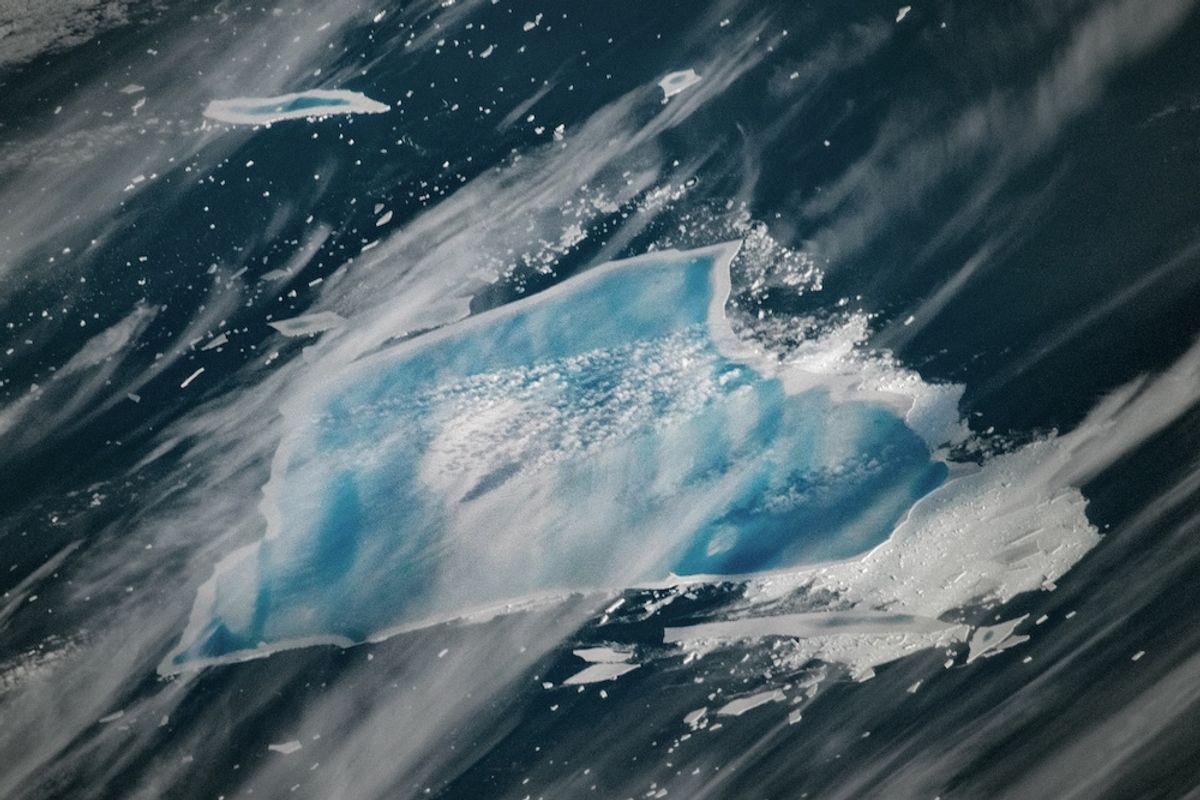
Once a towering giant of Antarctic ice, Iceberg A-23A is now riddled with pools of vivid blue meltwater as it drifts through the South Atlantic. Scientists say these watery blues are a sign that one of the longest-lived icebergs ever tracked may be approaching its final days.
A-23A first broke away from Antarctica’s Filchner Ice Shelf nearly four decades ago, beginning a surprisingly long and complicated journey. Today, it remains enormous – still larger than New York City – but it is only a fraction of its former self and rapidly nearing collapse.
Iceberg A-23A in Rapid Decline
When A-23A detached from Antarctica in 1986, it covered roughly 1,500 square miles – nearly twice the size of Rhode Island. According to estimates from the U.S. National Ice Center, the iceberg’s area had shrunk to just 456 square miles by early January 2026. Several large fragments broke away during July, August, and September of 2025 as the iceberg encountered warmer summer conditions.
A recent image captured by NASA’s Terra satellite shows what remains of the iceberg, looking waterlogged and unstable. The Moderate Resolution Imaging Spectroradiometer (MODIS) image, taken on December 26, 2025, reveals extensive blue pools across the surface, a feature scientists refer to as “blue-mush.” These areas likely mark zones where ice is thinning and breaking down from within.
The image also hints at a structural failure known as a “blowout,” a white scar where the pressure from pooled meltwater may have punched through the ice, allowing water to spill down to the ocean surface. Researchers say these signs suggest the iceberg could disappear completely within days or weeks.
Read More: New Species Identified On Antarctic Seafloor that was Once Covered By a Massive Ice Sheet
Why Warmer Waters Are Destroying A-23A
The iceberg’s location is working against it. A-23A is now drifting through waters around 37 degrees Fahrenheit and riding currents that will carry it into even warmer regions. The part of the Southern Ocean that A-23A currently calls home is known as a graveyard for icebergs, as it is a location where higher air and water temperatures accelerate the melting and disintegration of icebergs.
Seasonal conditions are making matters worse. Clearer skies and warmer summer air are allowing sunlight to penetrate the surface, heating meltwater pools that further weaken the iceberg’s internal structure. Once these processes begin, disintegration can happen rapidly.
The Unusual History of A-23A
Even by Antarctic standards, A-23A has had an unusually eventful life. After calving from the Filchner Ice Shelf, it became grounded in the shallow waters of the Weddell Sea for more than 30 years. When it finally broke free in 2020, it spent months trapped in a spinning ocean vortex before drifting north.
Along the way, the iceberg nearly collided with South Georgia Island and became lodged in shallow waters again before escaping into the open ocean, where it has steadily fractured. The linear- blue-and-white patterns still visible across its surface trace back hundreds of years, carved when the ice was once part of a glacier scraping across Antarctic bedrock.
As A-23A fades, other “megabergs” continue to linger along Antarctica’s coastline. But this aging giant’s long journey has reshaped scientists’ understanding of how massive icebergs evolve and how quickly they can disappear.
Read More: Glacier in Antarctica Caught Committing Ice Piracy From Its Neighbor
Article Sources
Our writers at Discovermagazine.com use peer-reviewed studies and high-quality sources for our articles, and our editors review for scientific accuracy and editorial standards. Review the sources used below for this article: