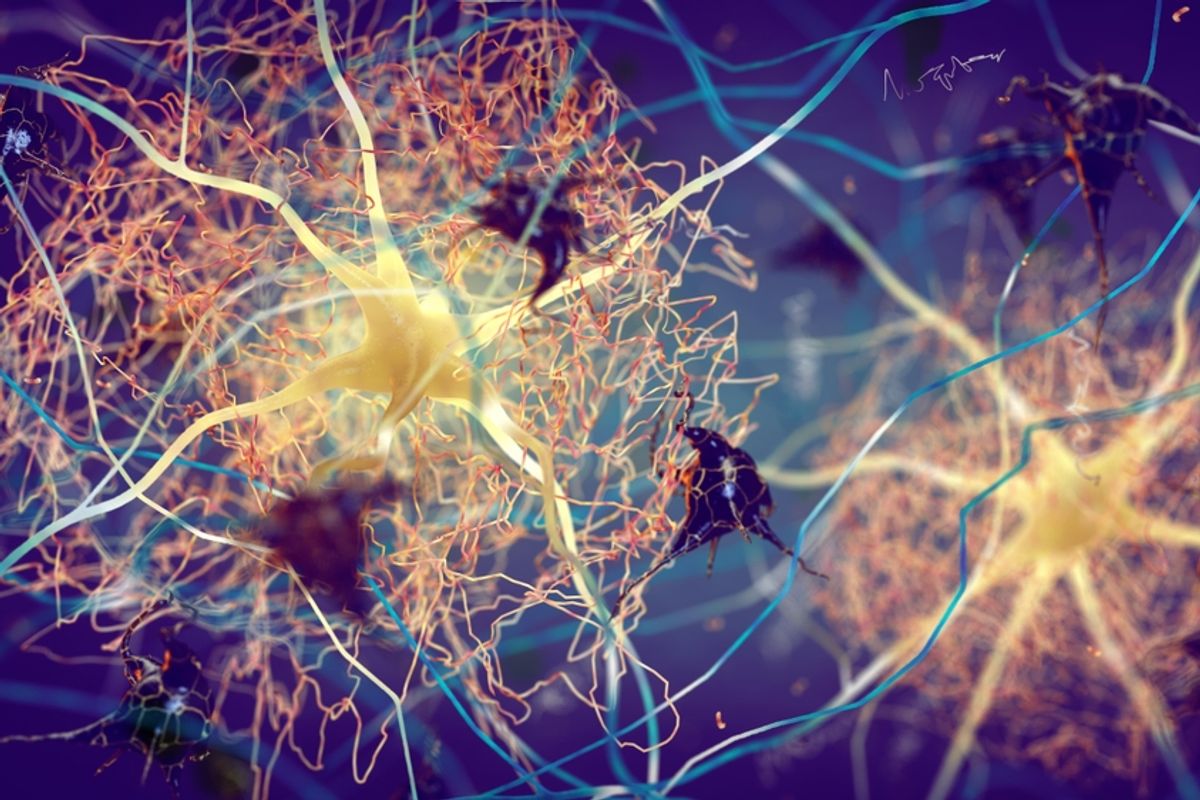
Auditory stimulation may be an effective Alzheimer’s treatment, with animal studies suggesting it has the potential to flush out senile plaques associated with the disease.
Researchers writing in PNAS recently described the first non-human primate study supporting the use of 40-hertz (Hz) auditory stimulation as a therapy option for Alzheimer’s, a neurodegenerative disease affecting over 7 million Americans, according to figures from the Alzheimer’s Association. According to the study’s authors, “the most important and unexpected finding” was that the benefit was prolonged, lasting five weeks or more.
Read More: Two Cancer Drugs Show Surprising Promise in Treating Alzheimer’s
Taking Inspiration From Alzheimer's Rodent Models
Alzheimer’s disease is linked to the abnormal buildup of senile plaques (or amyloid-beta protein deposits) and a second protein, tau, which can clump together to form neurofibrillary tangles.
In previous studies, scientists have used mouse models to investigate the effectiveness of using auditory stimulation to remove amyloid-beta via the cerebrospinal fluid — a liquid that (among other things) acts a lot like a waste disposal unit, removing junk from the brain.
While in many cases, the results have been promising, rodent models have limitations. Mouse brains are not like ours, and do not naturally develop Alzheimer’s. Hence, the need to test the therapy on brains that more closely resemble the human brain, for example, a rhesus macaque brain.
Replicating the Success in Primate Models
The team writing in PNAS recruited nine rhesus macaques, all exhibiting high levels of spontaneous amyloid plaques and all aged 26 to 31 years old (making them geriatrics in monkey years). These macaques were then randomly assigned to a control group and an experimental group. The latter was subjected to 40-Hz auditory stimulation for 1 hour per day for 7 days, consisting of 1-kHz pure tones delivered at 25 ms (milliseconds) intervals (i.e., at 40 Hz).
Once treatment was complete, the researchers measured levels of amyloid-beta (Aβ) in the monkeys’ cerebrospinal fluid (CSF). Excitingly, they found that those in the experimental group saw “a rapid and significant increase” — specifically, a 205.61 percent increase in Aβ42 and a 201 percent increase in Aβ40.
“We speculate that 40-Hz auditory stimulation promotes the flush of Aβ proteins from the intercellular fluid to the CSF through activation of the glymphatic system, which in turn leads to the elevation of the CSF Aβ protein levels,” the study’s authors wrote.
Essentially, the results suggest that the stimulation promotes the expulsion of amyloid-beta from the brain via the cerebrospinal fluid, which is why higher levels of the protein were detected.
Impressively, a second measurement five weeks later found the proteins remained at elevated levels, suggesting longer-term benefits to the treatment — an effect not seen in previous studies involving rodents.
The team also measured tau levels but found the stimulation had no noticeable effect. A later post-mortem analysis of the monkeys’ brains showed amyloid plaques were “prevalent,” whereas tau tangles were "negative or very weak,” suggesting low levels of tau in the cerebrospinal fluid may not have been particularly significant.
Finding An Effective Therapy For Alzheimer’s
While there is no known cure for Alzheimer’s disease, there have been some recent wins when it comes to finding drugs that can slow disease progression by reducing or reversing the buildup of amyloid-beta. But these anti-amyloid drugs do appear to come with some very serious side effects, including brain swelling and brain bleeding. Auditory stimulation, in contrast, may offer a low-cost but effective — and non-invasive — therapy for Alzheimer’s disease, the most common form of dementia and the leading neurodegenerative disorder globally.
Still, though these results appear positive and are relatively consistent with earlier models involving mice, it is worth noting that it is still an animal study, and macaques are not the perfect replica for the human brain. And while there have been early-stage clinical studies, including one in PLOS One, looking at the effect of 40-Hz light and sound stimulation on Alzheimer’s patients, these are — as the name suggests — early-stage.
The researchers hope that future studies will examine the process by which amyloid beta is cleared from the brain in greater detail.
This article is not offering medical advice and should be used for informational purposes only.
Read More: Repairing the Blood Brain Barrier Reversed Alzheimer's Disease in Mice, a Hopeful Result for Humans
Article Sources
Our writers at Discovermagazine.com use peer-reviewed studies and high-quality sources for our articles, and our editors review for scientific accuracy and editorial standards. Review the sources used below for this article: