
Remember me
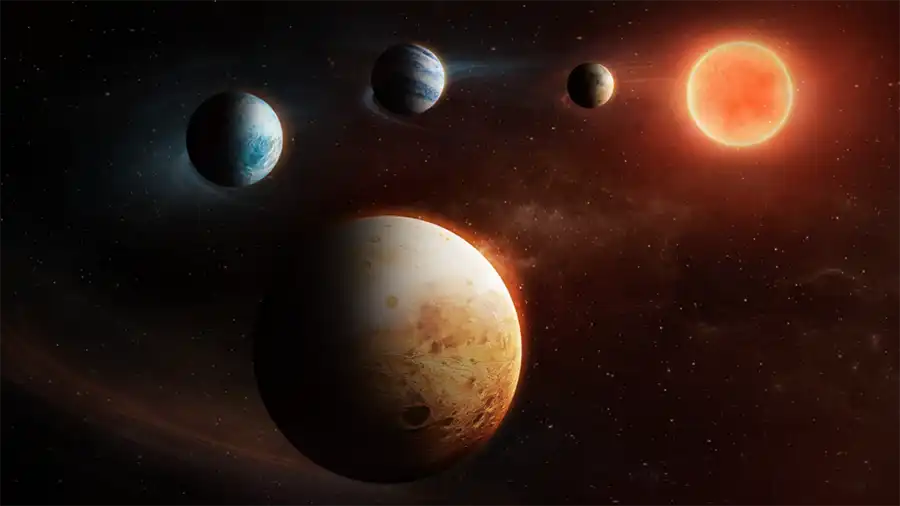




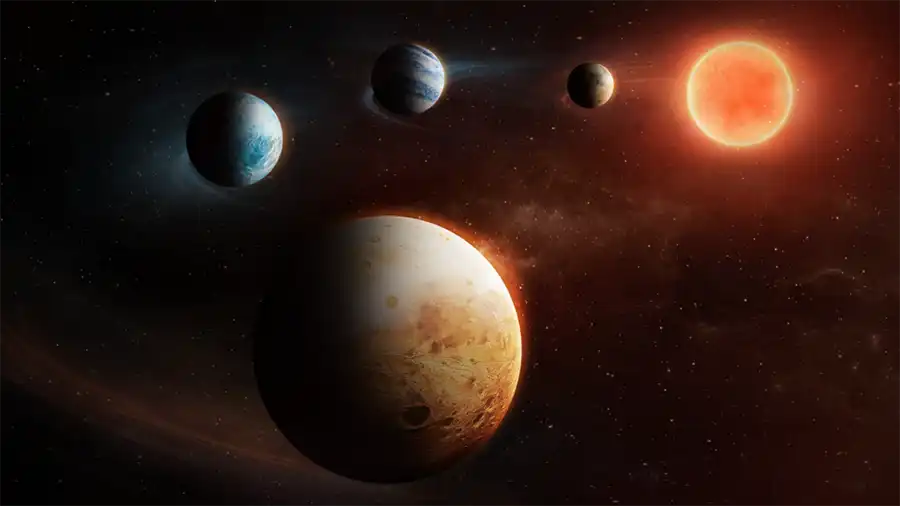 Artist’s illustration of the LHS 1903 planetary system (not to scale).
 Astronomers have identified a four-planet system around a low-mass M-dwarf star. The unusual ordering of rocky and gas-rich planets complicates our standard picture of planetary formation.
In most planetary systems, terrestrial worlds orbit closest to their star, while planets with extended gaseous envelopes lie farther out. But around LHS 1903, a red dwarf 116 light-years from Earth, its outermost planet is rocky, with a radius 1.7 times that of Earth and almost six times as massive, even though two inner neighbors retain extended atmospheres.
In a new study published in Science, researchers led by Thomas Wilson (University of St. Andrews, UK) combined observations with simulations to determine whether the outermost planet, LHS 1903 e, could have migrated from other parts of the system or lost its atmosphere in later stages of its evolution. But after considering a range of scenarios, researchers argue that the planet most likely formed as a terrestrial world, accreting in a gas-depleted environment to begin with.
Scientists first became interested in the system when NASA’s Transiting Exoplanet Survey Satellite (TESS) revealed the first three planets. “We were excited by the initial detection,” Wilson says. Multi-planet systems offer a rare opportunity to compare worlds that formed from the same protoplanetary disk.
Then follow-up observations with the European Space Agency’s Characterising Exoplanet Satellite (CHEOPS) and ground-based telescopes uncovered a fourth object and refined all of the planets’ sizes and masses. These data showed that the outermost world, LHS 1903e is dense and gas-poor — even though it’s farthest out from its star. That puts the planet in an awkward position.
A Valley Between Two WorldsOver the past decades, astronomers have found that small exoplanets tend to cluster into two groups. Dense, rocky worlds similar in size and composition to Earth are usually found closer to the star, while larger planets wrapped in thick envelopes of gas, often compared to Neptune, orbit at a greater distance. Planets between Earth and Neptune in size are amongst the most common worlds in the galaxy, yet within that dominant population lies a subtle dip in occurrence, for planets just less than twice the Earth’s radius. The phenomenon is known as the “radius valley.” Many astronomers attribute this gap and ordering to atmospheric escape, in which intense stellar radiation strips gas from closer planets, while more distant worlds retain their gaseous envelopes.
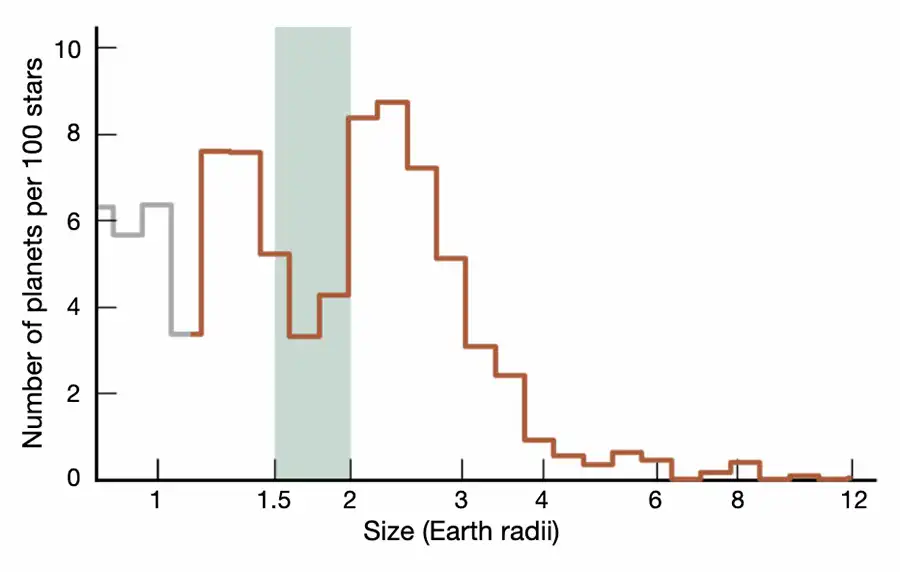 While super-Earths and sub-Neptunes are the most common planets in the galaxy, there's a subset of planets just smaller than Earth that appears to be scarcer than their planetary siblings. LHS 1903e, with a radius 1.7 times Earth's, falls in this "radius valley."
Yet in LHS 1903, the density of the two middle planets shows that they’re gas-rich, while the density of the outermost planet is similar to Earth’s, suggesting it has no thick envelope at all. If atmospheric escape were the sole factor responsible for LHS 1903 e’s rockiness, its inward neighbors ought to have lost their atmospheres already.
James Owen (Imperial College London), who was not involved in the study, says the system provides a rare example of a smaller planet from the radius valley being found farther out from its star.
“The one caveat known to the [expected ordering],” Owen explains, “is when a planet farther from its star is less massive and struggles to hold onto its atmosphere even at weaker irradiation levels.” But in this system, the outer planet appears to be more massive than a gas-rich inner neighbor.
Considering AlternativesArmed with these observations, the team simulated alternative scenarios for the system’s evolution, but none of them panned out. A giant impact might have been energetic enough to strip the outer planet’s atmosphere, but it also would likely have destabilized the system. Yet the current configuration appears stable. A prolonged bombardment of smaller impacts could have done the trick, too, but that would probably also have affected the inner planets.
“It could be that the outer planet migrated in from a farther region,” Wilson says, “but then it should have had even more gas, making the picture even more confusing.”
In the end, there’s an alternative that remains. Sara Seager (Massachusetts Institute of Technology), who contributed to the study, says the system “is suggestive of formation in a depleted disk environment.” In other words, while early-forming planets would have had access to abundant gas, allowing them to build thick atmospheres, the stars’ winds and radiation would have cleared out the gas eventually. If the outer planet formed later, it would have assembled after much of that gas had dispersed, remaining largely rocky.
The scenario is surprising and hinges on the planet’s mass measurement. “Planet formation is the most difficult area for exoplanet study,” Seager adds. “The mass uncertainty propagates directly into the strength of our conclusion.” But if the mass pans out, Owen says it suggests the atmospheric-escape model, while successful around Sun-like stars, might not map as neatly onto M-dwarf systems. LHS 1903e might offer a clue that multiple processes might be at work.
More examples of such planets would be needed before composing a new theory of planet formation. “In exoplanets, when there’s one, there are usually more,” Seager says. “So hopefully there will be more data points soon.”
Vincent Van Eylen (University College London), who was not involved with the study, is hopeful that the European Space Agency’s upcoming Planetary Transits and Oscillations of stars (PLATO) mission, expected to launch in 2027, will provide an opportunity to find “more long-period planets and potentially confirm results like these.”
For Wilson, the broader lesson is that planet formation may not follow a single script. “No longer can we rely on the standard approach that rocky planets only form close to their stars and gas-rich worlds further away,” he says. “The more we look at exoplanets across the Milky Way, the more we understand that the solar system is unique, and that planets can be built in all shapes and sizes.”