
Remember me
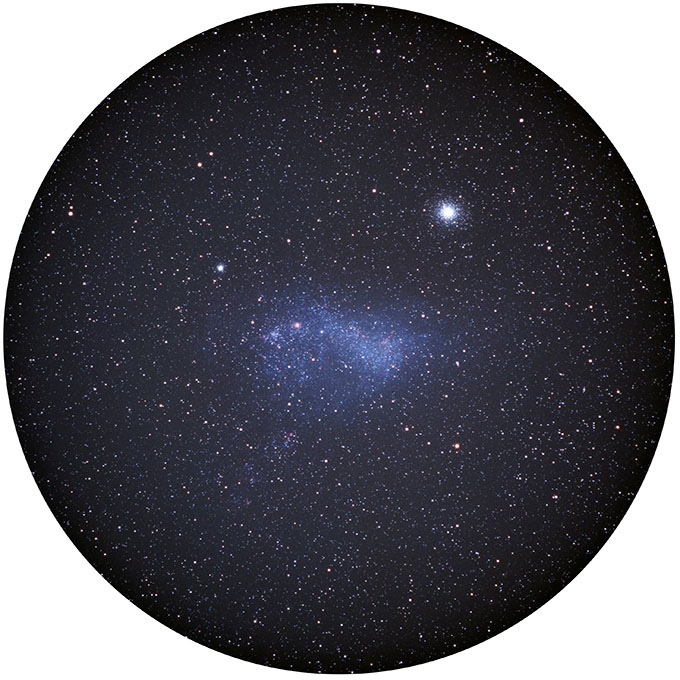
 The Small Magellanic Cloud is at center (with globular cluster 47 Tucanae to the upper right).
Some 200,000 light-years away, a small galaxy is undergoing a transfiguration.
The galaxy, named the Small Magellanic Cloud (SMC), is the less massive companion to the Large Magellanic Cloud (LMC) — both visible as hazy features in the Southern Hemisphere sky. The dwarf galaxies — containing only a few billion stars, compared to the Milky Way’s hundreds of billions of stars — are only 75,000 light-years apart.
Now, astronomers, led by graduate student Himansh Rathore (University of Arizona), have confirmed that the SMC collided with the LMC only a few hundred million years ago. In a new study to appear in The Astrophysical Journal, they detail the collision’s reverberations across the smaller dwarf galaxy, which disrupted its gas and stars.
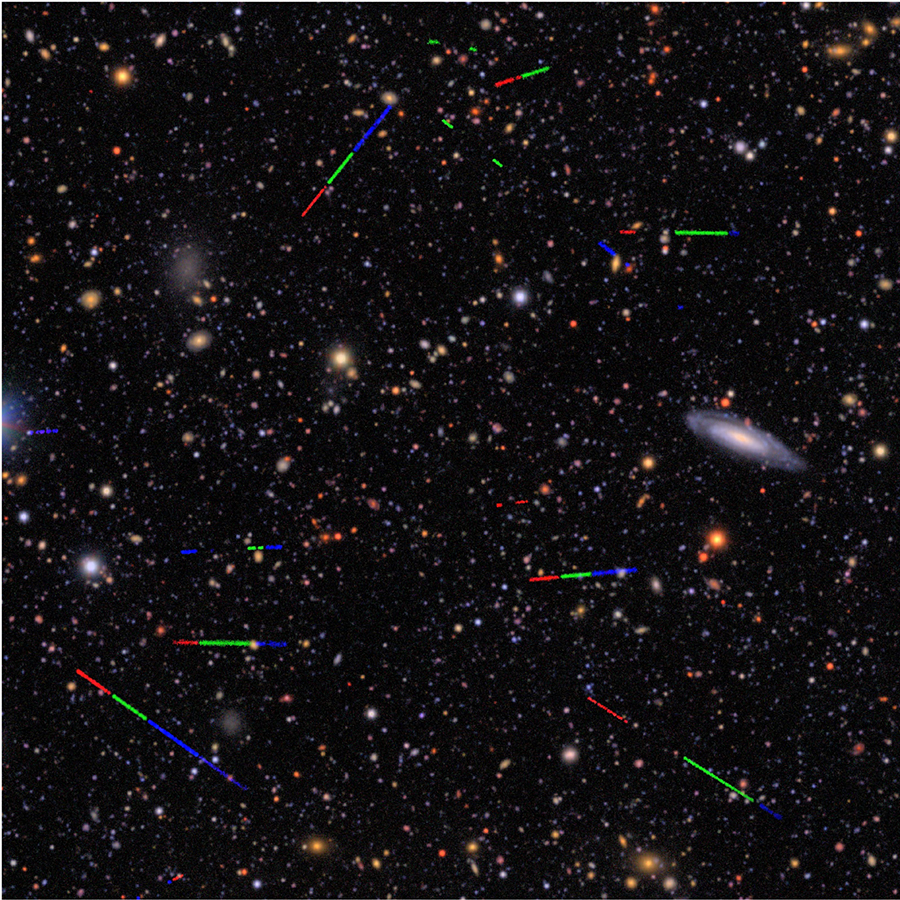
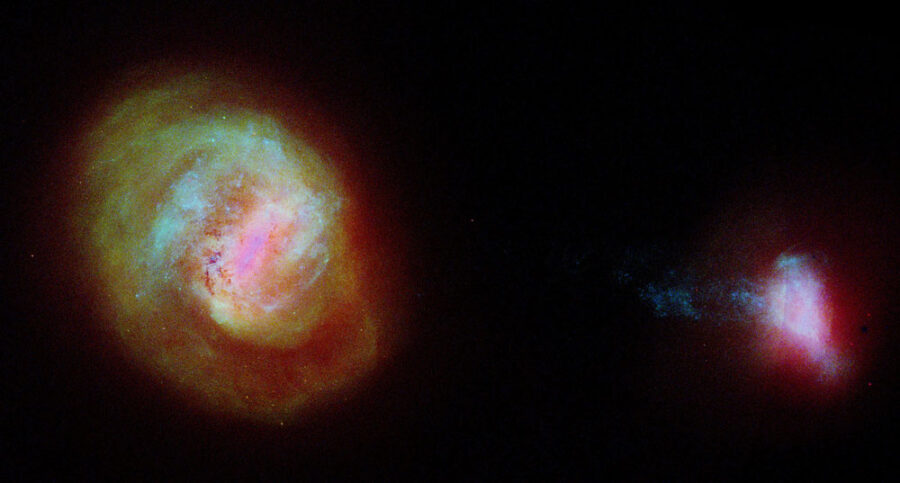 This image shows the stellar density of the Large and Small Magellanic Clouds, as seen by the Gaia space telescope. Red, green and blue layers trace older, intermediate, and younger stars, respectively. A bridge of younger stars extends from the SMC toward the LMC.
 The team found that our observations of the galaxy align exactly with what we would expect to see from such a cataclysmic collision — the LMC’s gravitational forces shearing apart gas and stars. The pair present an opportunity to observe interacting galaxies in incredible detail.
“The SMC has always been a puzzle,” says Marla Geha (Yale University), who wasn’t involved in the study, “and [the] work explains many of the SMC’s oddities with a single plausible story.”
A Galactic TransformationThe discovery resolves a long-standing discrepancy that had puzzled astronomers observing the SMC: Its gas appeared to rotate, while the stars did not. This disagreement should not be possible, since stars are born out of gas.
But the team’s results tell a different story. Rathore’s team found that a collision would shred the gas apart in different directions, creating motion that’s difficult to distinguish from rotation. Post-collision, the gas would be tugged outwards, while the disrupted stars would be moving about in random motions.
The discrepancy comes down to a fundamental limitation in observing those motions. Using spectroscopy, astronomers can’t see how gas moves across the sky, only whether it’s moving toward or away from us. And in the SMC, one side of the galaxy appears to move toward us and the other side away — typically a tell-tale sign of a rotating disk.
However, the team found that a collision could produce similar motions in the SMC, due to the gravitational force of the nearby LMC. As the two galaxies passed through each other, the LMC began tugging on the SMC’s streams of gas, just as the Moon tugs on Earth’s oceans to create beaches’ high and low tides. As viewed from Earth, one part of the stretched-out gas would appear to move away from us while another part would come toward us — motions that are indistinguishable from rotation.
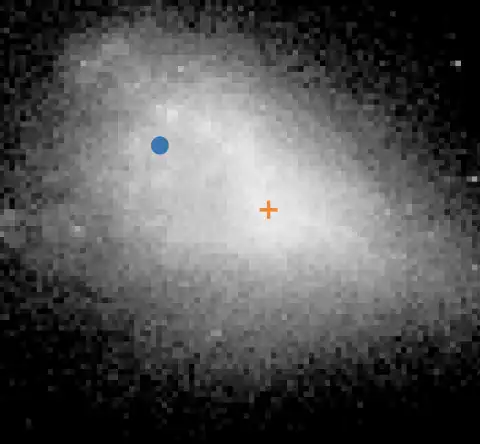 The stars' center of mass (orange) is light-years away from the center of mass of the dwarf's gas (blue).
 While the gas motions were the smoking gun, other clues also pointed to a collision. For one, the stars have a different center of mass than the gas. That’s because the LMC’s own cloud of gas and dust exerted intense pressure as the galaxy streamed through the SMC. This force, called ram pressure, strips only gas, effectively pushing it away from the stars.
The entire galaxy also appears elongated, another indicator of tides. In addition, when astronomers wind the clock back based on the two galaxies’ current speeds and directions, they pass right through each other.
“What was missing,” says team member Gurtina Besla (University of Arizona), who advises Rathore, “was the theoretical framework to actually understand how that could possibly happen, to actually show that a collision could do it.”
An Analog of the Early UniverseThe SMC’s diminutive size has slowed its evolution compared to more massive galaxies around us today. It forms fewer stars and produces fewer heavy elements compared to other, larger galaxies today. Despite its recent collision, or perhaps because of it, the SMC could make for a good analog for galaxies that formed in the early universe.
“At early times, everything’s smashing into everything,” Besla says. Studying the SMC’s collision could provide a window into the chaotic environment of the early universe. But first it’s crucial to understand how the SMC was transformed by its epic crash with the LMC.
For example, both the SMC and LMC are experiencing a huge burst in star formation, likely induced by their collision. The SMC is now a testbed to investigate how collisions compress gas to form stars. The team will create models of the SMC-LMC collision to better understand the effects of the galaxies’ interactions affected the SMC’s sea of stars, clouds of gas and dust, and the invisible halo of dark matter that pins it all together.
“There’s an insane amount of data that is there ready to extract fundamental physics, but we need models to match it,” Besla says. “This [study] is the first step.”
 The Small and Large Magellanic Clouds float above an African savanna.
 The result provides a new perspective on the Magellanic Clouds, a pair which — being visible to the naked eye — have long fascinated us. “We’ve known these galaxies since there have been humans,” Besla says. “So we’ve always been thinking about them as being part of our mythologies or culture in the Southern Hemisphere.”
Many cultures reference the clouds, often as a pair. For example, Australian Aboriginal cultures envision the clouds as two cranes, or as an old couple sitting by the campfire.
“This [discovery] is now putting it in a slightly different lens, where it’s not just that they’re companions, but that they have actually exchanged material,” Besla says. “They’ve been intimately connected.”
Comments (0)