
Remember me
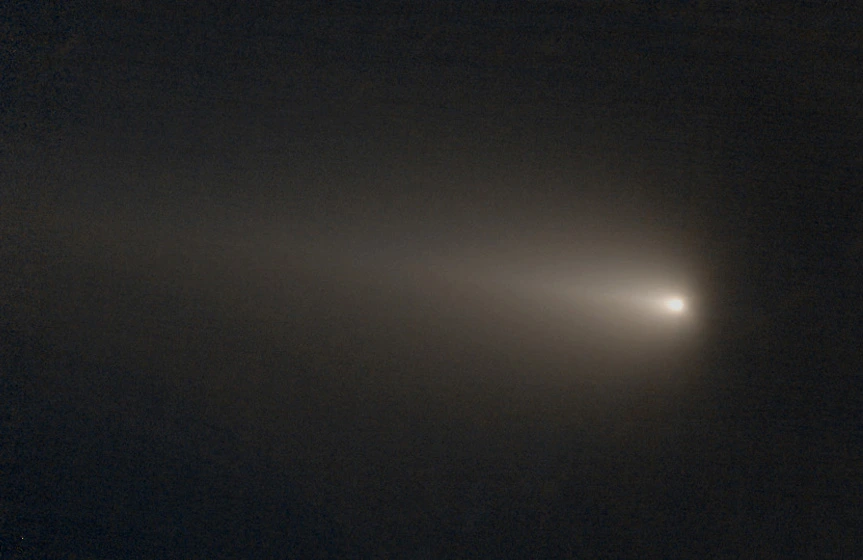

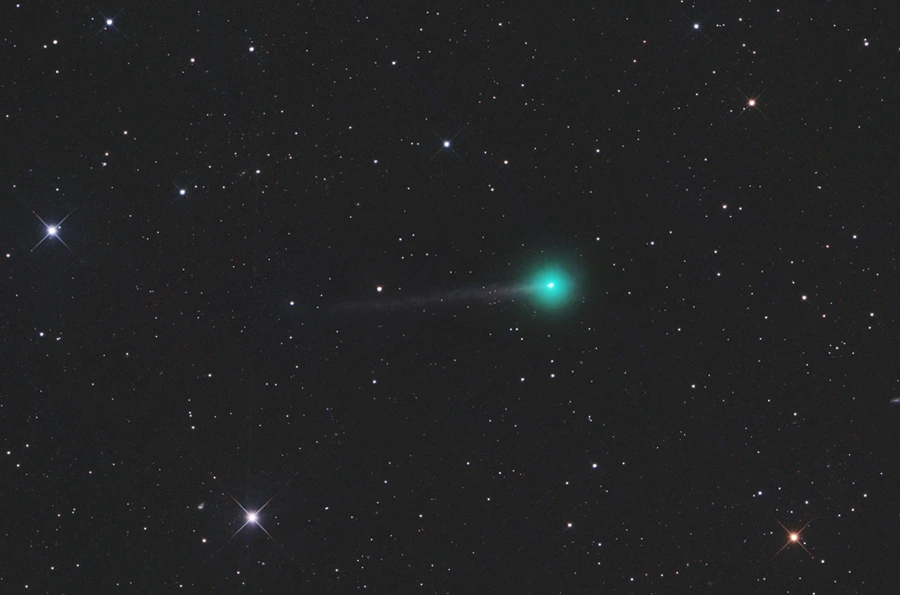 On March 14th, comet C/2026 A1 MAPS displayed a blue-green coma with a well-condensed nuclear region, as well as a faint, 25′ tail pointed east-southeast. North is up.
 We're all wondering the same thing. How bright will Comet C/2026 A1 MAPS get? Will it become a splendid sight like some of its sungrazing siblings of the past or will it fracture and fade? With perihelion less than three weeks away, a definitive answer is lacking, but we can still speculate. First, let's examine its recent behavior.
Between March 6th and March 9th, C/2026 A1 quickly brightened by almost 1.5 magnitudes, from 12 to 10.5. At the same time, its coma (the comet's gaseous envelope) expanded 50% from 6′ to 9′, and its core became more compact. Exciting news! Then from March 11–17, in a seeming setback, the comet's brightness plateaued and its well-condensed coma shrank back to 6′.
Regardless, these swift changes made it possible to finally catch a brief glimpse of this fickle fuzzy through my telescope. Comet MAPS has been notoriously difficult to spot due to its very low altitude (less than 10°) in the western sky at the end of evening twilight. I pinned it down in the trees just a few degrees above the horizon on March 13th. Through my 15-inch Dobsonian reflector, I saw a moderately condensed coma that spanned about 4′ with an overall magnitude of 10.0.
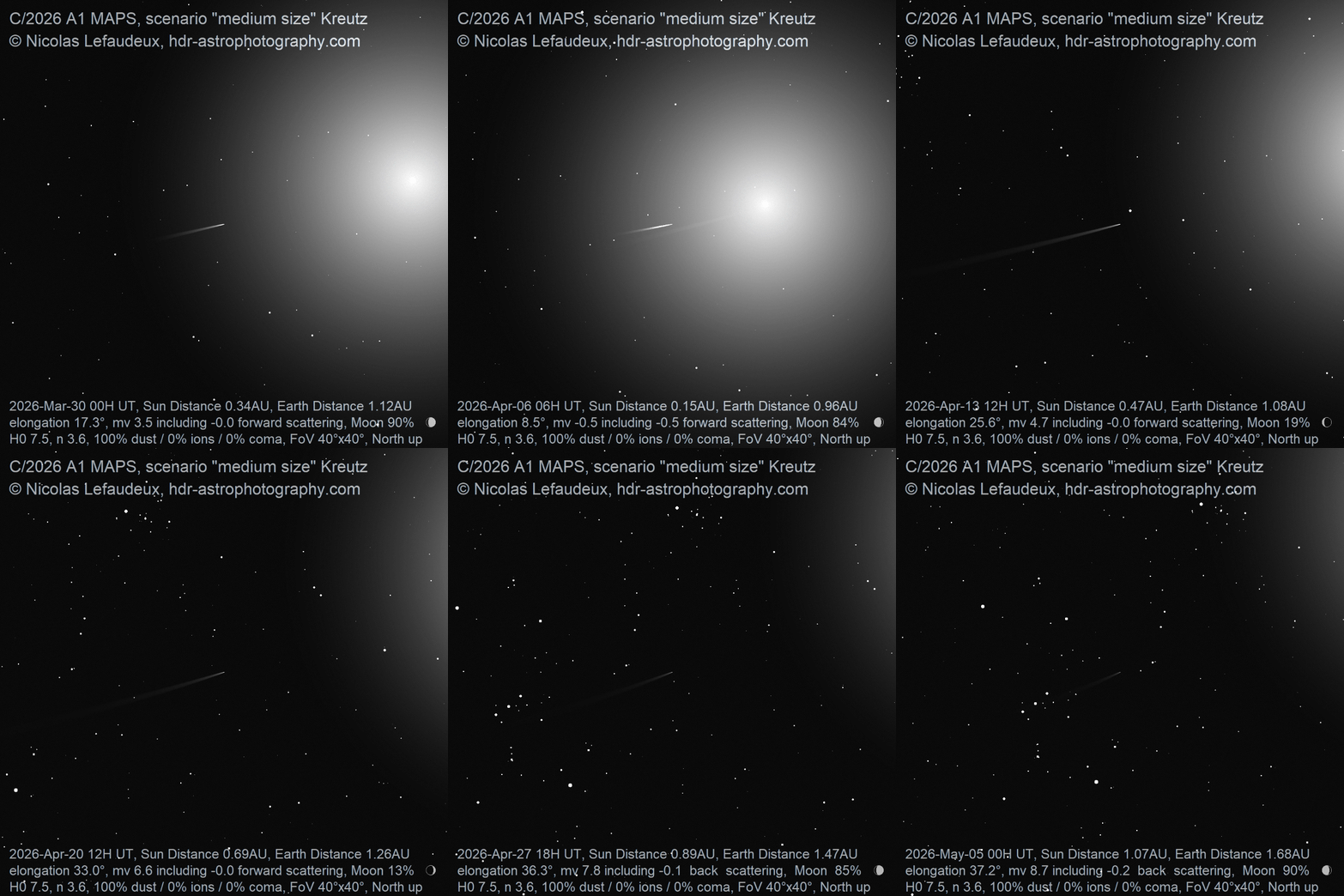 In this scenario, the comet survives perihelion on April 4th and reaches a peak magnitude of around –9. It may be impossible (and dangerous!) to see it visually since the comet passes only a few arcminutes from the Sun. Perhaps a properly baffled and filtered telescope and camera would be able to record it. Space-based coronagraphs like those on the Solar and Heliospheric Observatory (SOHO) may capture a unique happening. "As the comet recedes after perihelion, a new tail forms, potentially appearing alongside remnants of the pre-perihelion tail," according to Nicolas Lefaudeux. Comet MAPS would exit the solar glare around April 7th with a 5° to 10° east-pointing tail, then quickly fade. See all simulations and full descriptions.
French optical engineer and amateur photographer Nicolas Lefaudeux has kept abreast of the comet's evolution and created tail simulations based on four possible scenarios:
Pre-perihelion breakup — Comet C/2026 A1's nucleus crumbles, destroyed by intense solar heating and gravitational tides. Comet ISON may have experienced a similar fate during its 2013 apparition. In this scenario, only a faint remnant of C/2026 A1 remains. Rating: A fizzler. "Headless" comet (post-perihelion breakup) — The comet's nucleus survives perihelion but breaks apart shortly after, producing a ghostly head with a bright tail perhaps as long as 15°. Rating: Great object for amateur astronomers, much less so for the public. Medium-sized Kreutz comet — Comet survives perihelion intact to become a bright object somewhere between Comet Lovejoy (C/2011 W3), which reached peak brightness between magnitude –3 and –4, and Comet Ikeya-Seki (C/1965 S1) at magnitude –10. Rating: Primarily an object for amateur observers but gathering some public attention. Ikeya-Seki-sized Kreutz comet — C/2026 A1 would emerge from the solar glare on April 7th at magnitude –10 with a 10° tail that would grow to 30° by mid-month. Rating: Knock your socks off.Of course, always take comet forecasts with a grain of sodium chloride. Lefaudeux's simulations are based on reasonable expectations tied to current observational trends.
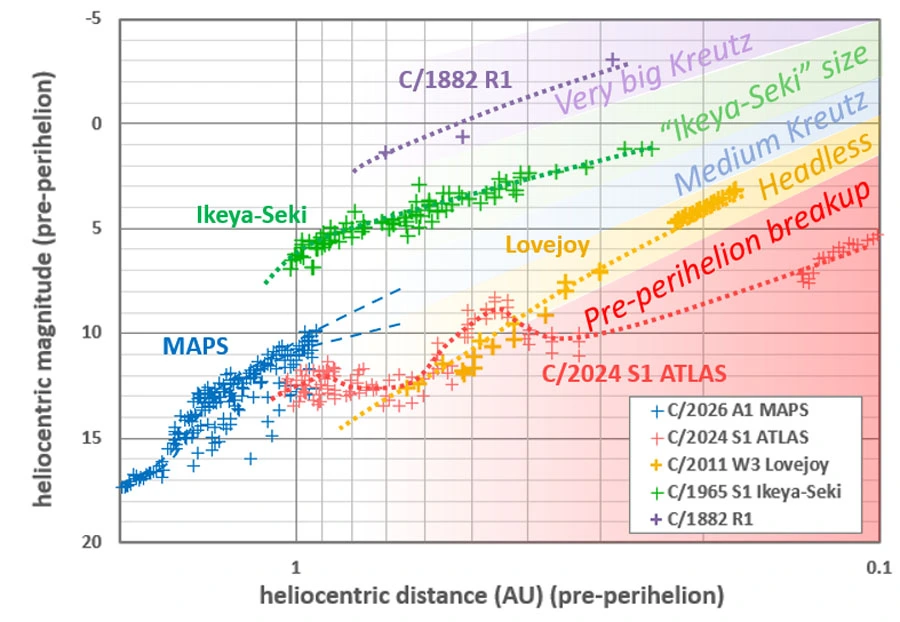 This diagram summarizes four possible outcomes for Comet MAPS during its perihelion passage, which occurs around 13:19 UT on April 4th. The graphic plots magnitude (left) against solar distance in astronomical units. The most likely scenario for the comet at the moment is the "Medium Kreutz" slot.
 "Nothing will be certain until a few days after perihelion, as it is the dust released between ~6 hours and 3–4 days after perihelion that mostly determines the tail’s length and brightness," said Lefaudeux. Assuming that C/2026 A1 survives, we would expect to see a narrow, bright tail because Earth will lie near the comet's orbital plane, similar to seeing Saturn's rings edge-on at its equinoxes.
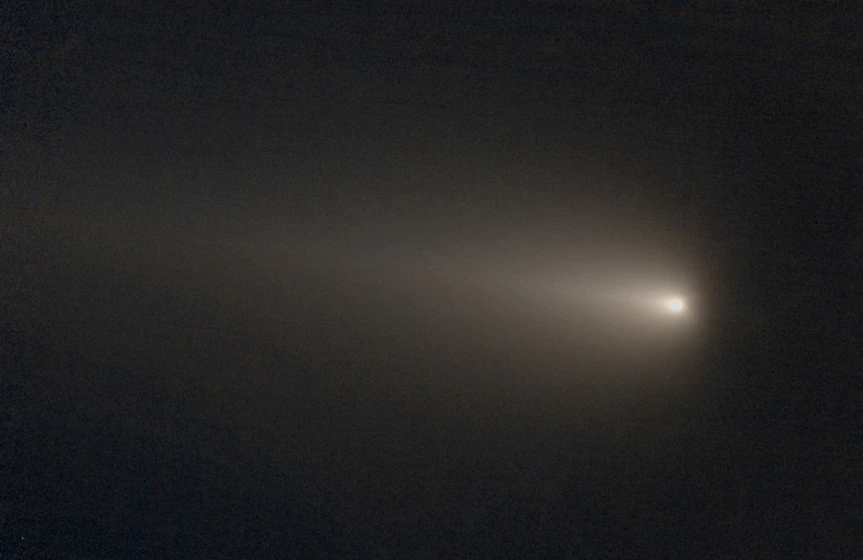 Qicheng Zhang and his team used the Mid-Infrared Instrument (MIRI) on the James Webb Space Telescope to photograph Comet MAPS on Feb. 7, 2026.
 In the just-published paper, Preliminary Nucleus Size Estimate for Kreutz Sungrazer C/2026 A1 (MAPS), Qicheng Zhang and his team used the James Webb Space Telescope to nail down the size of the nucleus to approximately 0.4 kilometer, or ¼ mile — similar to Comet Lovejoy's.
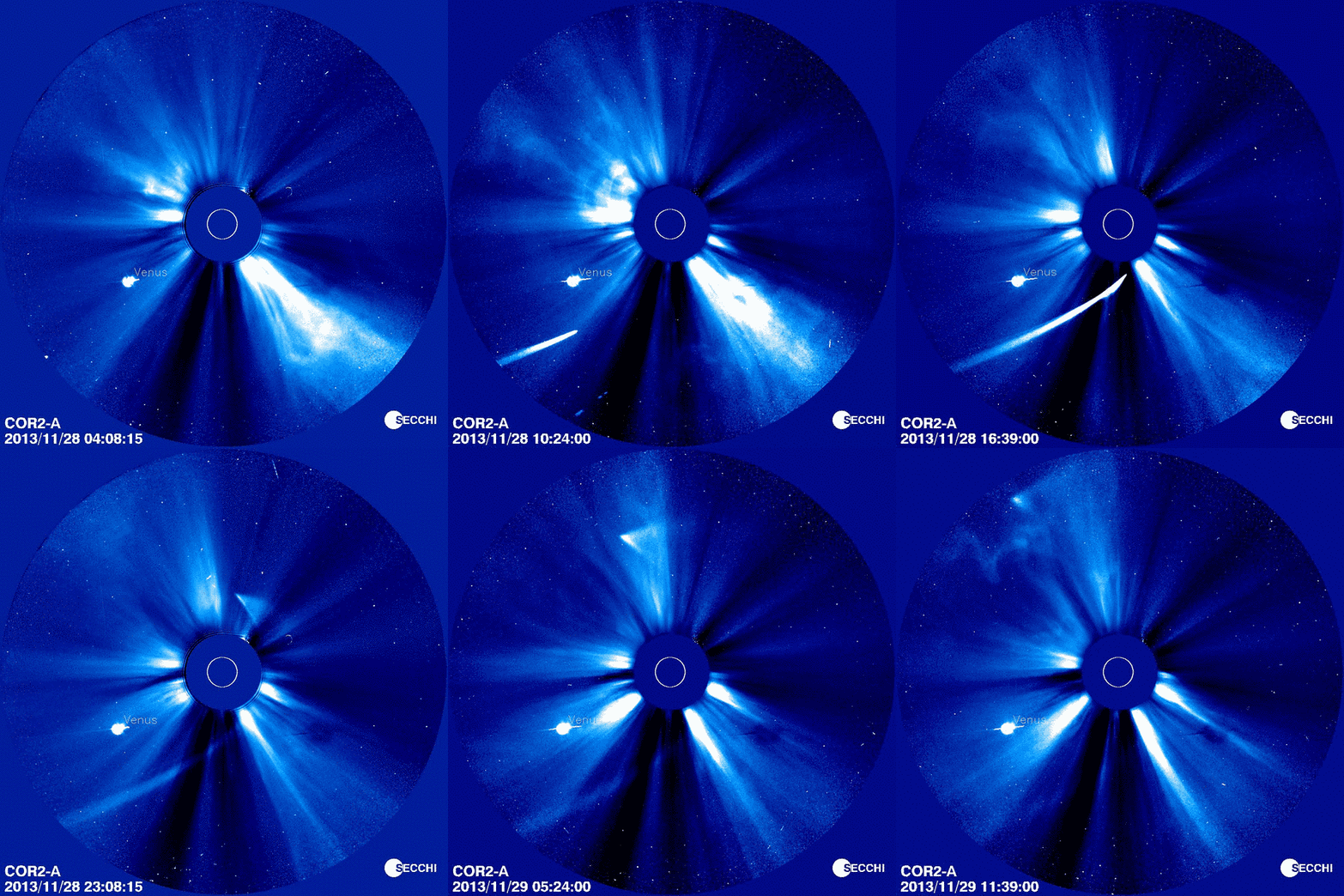 NASA's STEREO-A COR2 coronagraph captured this animation of Comet ISON's disruption in late November 2013, starting a week prior to perihelion. After rounding the Sun, the comet was reduced to dust and rubble. One possibility for its demise was a spun-up nucleus from outgassing. Comet MAPS may undergo a similar fate.
"That suggests C/2026 A1 could still survive perihelion," writes Zhang. Lovejoy pulled through and briefly became a bright, fetching object with a long tail. But given MAPS's high level of outgassing (ice vaporization due to solar heating), Zhang offers a second possibility. Thruster-like torques from comet jets could literally spin the nucleus apart "before it even enters the fields of coronagraphs." Then it would become another ISON.
Fortunately, we'll be able to watch C/2026 A1 make a hairpin turn around the Sun in SOHO's wide-field LASCO C3 and narrow-field LASCO C2 coronagraphs. It will enter the former's field of view from the lower left early on April 2nd and pass through perihelion some 160,000 km (100,000 miles) above the Sun's farside surface on April 4th at 9:13 a.m. EDT. The comet swiftly swings around to the solar nearside and departs the C2 field around 1 a.m. EDT April 6th.
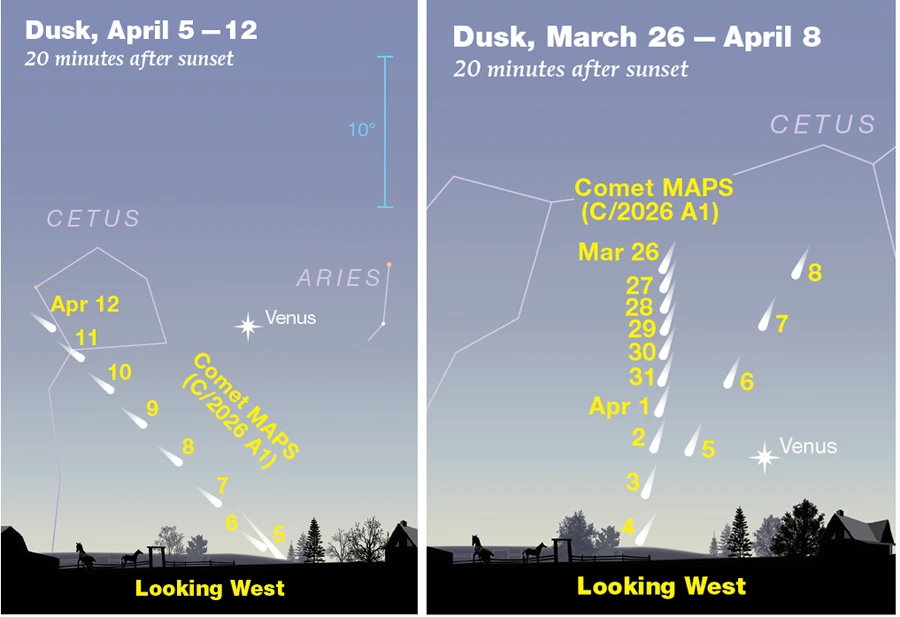 The best time to view the comet, assuming it survives its solar encounter, will be right after perihelion, low in the western sky during evening twilight. The left map shows the view from the Northern Hemisphere, the right from the Southern Hemisphere. Comet MAPS will display a narrow, bright tail. When seeking the object be sure to bring along a pair of binoculars!
 Amateur astronomer and comet discoverer Michael Jäger, whose superb images have graced the pages of Sky & Telescope for decades, is curious why MAPS is producing so little dust. Dust adds pizzazz to comets.
"Is the nucleus so dust-free from its last passage near the Sun that it has developed a hard crust?" he asks. "Or is it a small, gas-rich comet that’s on its last legs?" He hopes his first assumption is correct, in which case "we'll have a show." There's only one way to know for sure. You guessed it — keep your eyes on the comet!
Comments (0)