
Remember me
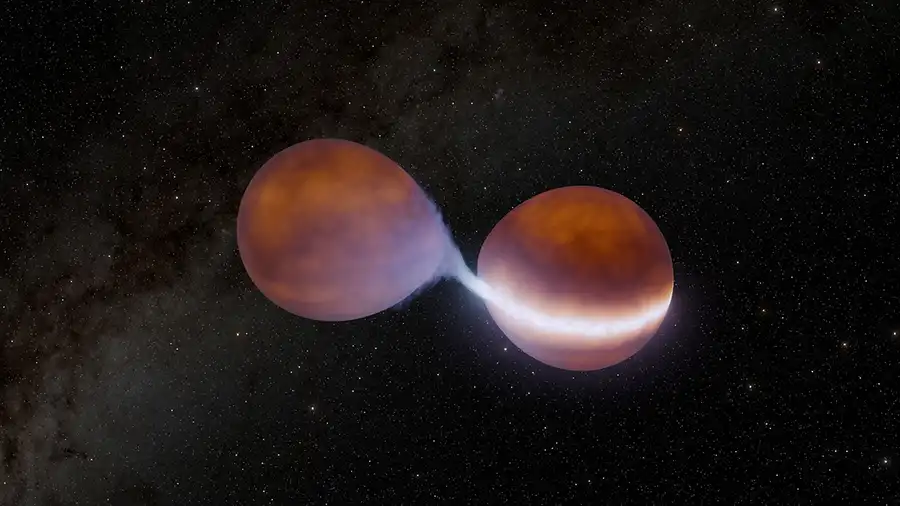
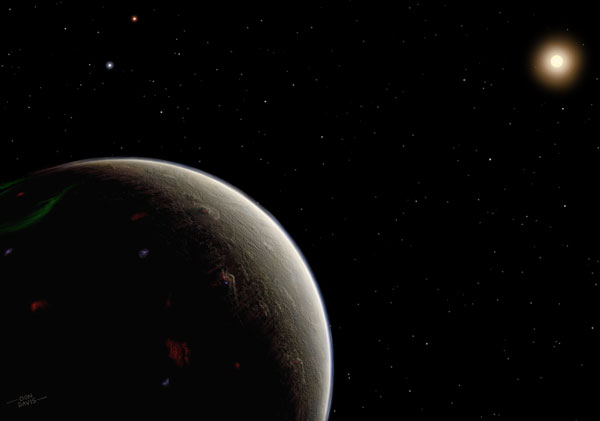
 Tau Ceti e, the world that's central to the film, is picture at top right. (The world's colors are muted here; they're more vivid in the film.)
When scientist Ryland Grace first looks out the window of his spacecraft, he sees what he believes is the Sun, and he thinks he’s not too far from home. He’s wrong — he doesn’t yet realize how far he’s come on a mission to save all life on Earth.
Grace, played by Ryan Gosling, is the reluctant hero of Project Hail Mary, in theaters March 20th. Based on the best-selling 2021 novel by Andy Weir, who also authored The Martian, Project Hail Mary balances fascinating and well-researched science with a compelling narrative, showcasing the quiet power of perseverance and friendship.
While I highly recommend the movie, this is not a review. It’s a real-life look at the stars and planets of Project Hail Mary — if they exist.
(Note: This post contains some spoilers.)
Tau Ceti and "Adrian"It turns out the star Grace is visiting isn’t the Sun — it’s Tau Ceti, a Sun-like star 11.9 light-years from Earth. In the film, Tau Ceti is the one star in the solar neighborhood that isn’t dimming at a radical pace, thanks to a black gooey lifeform known as “astrophage.” That anomaly is what spurs Grace’s journey to the star.
In real life, Tau Ceti is a yellow-orange G8 star that’s slightly less massive than the Sun. At magnitude 3.5, it’s visible to the unaided eye in the constellation Cetus. In fact, its proximity and Sun-like spectrum led astrobiologist Frank Drake (NRAO) to point an 85-foot (26-meter) radio dish at it back in 1960. The star was a target of Drake’s Project Ozma, the forerunner of modern surveys looking for extraterrestrial intelligence; however, the search came up empty.
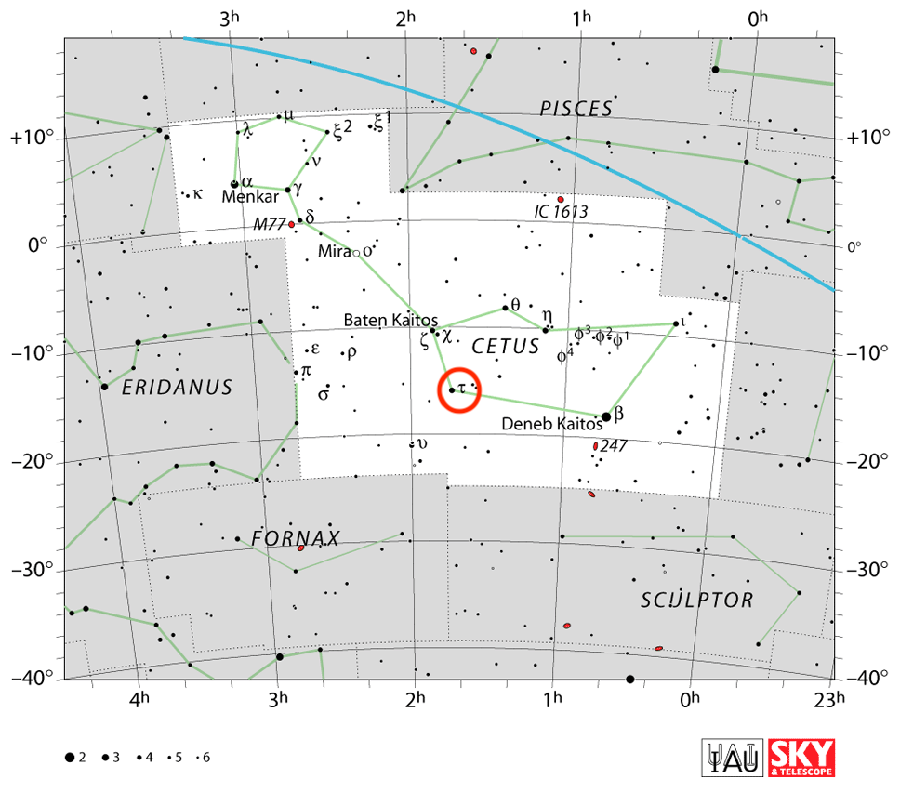 Tau Ceti (circled) belongs to the constellation Cetus, the Sea Monster.
Drake didn’t know it when he did his investigation, but there’s a chance that Tau Ceti hosts planets on which life could theoretically form. But whether Tau Ceti e — which Grace renames Adrian — actually exists is still unclear.
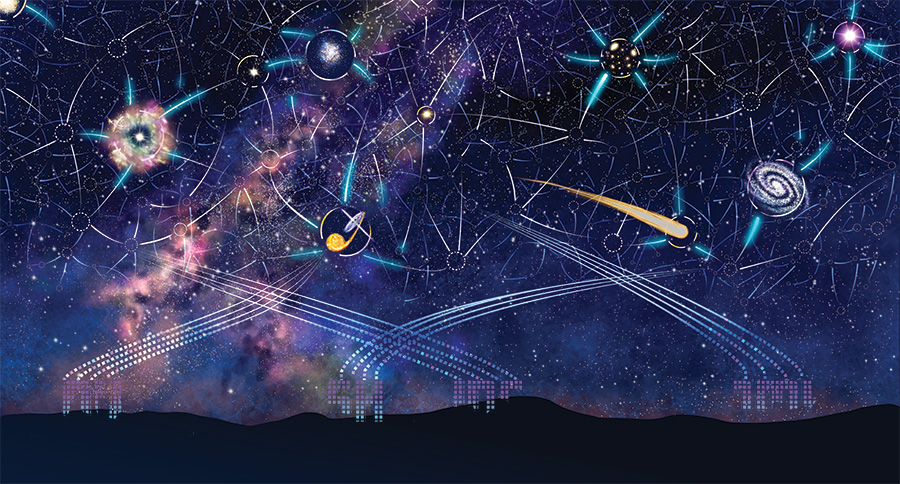
In 2012, astronomers announced the discovery of five planet candidates around Tau Ceti. If a planet orbits a star, its gravity tugs on that star slightly, a signal we can see in the star’s radial velocity (its motion toward or away from Earth). Only two of those planetary signals turned up in additional data published in 2017; one of those was Tau Ceti e.
The other signals weren’t from planets but from stellar activity or chance fluctuations in background noise. This is a limitation of the radial velocity technique. What appears to be a planet’s gravitational tug on the star as a whole can instead be motions on the star’s visible surface. And because the tugs of terrestrial worlds are particularly small, it’s possible that background noise can briefly masquerade as a real planetary signal. The cure for both these ills is more data — more observations of the star itself as well as its radial motions.
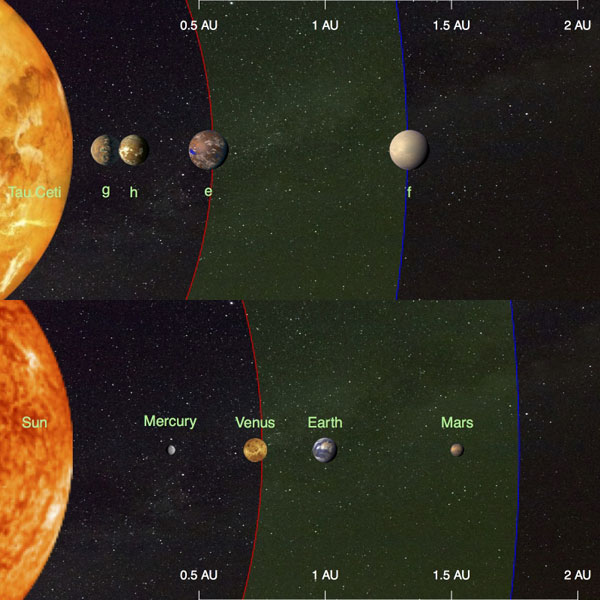 This illustration compares the four planet candidates detected around Tau Ceti (top), compared against the inner planets of our solar system (bottom). Those planets, still listed as "confirmed" in NASA's exoplanet catelog are now accompanied by a "controversial" flag noting their contested status.
Following up on the Tau Ceti planets, a team of astronomers took additional observations in 2025 with the ESPRESSO instrument on the European Southern Observatory’s Very Large Telescope in Chile, finding no evidence of any previously reported planets around the star. ESPRESSO takes high-resolution measurements of radial velocity that should have enabled it to see the signal from Tau Ceti e, the team says. NASA still lists it as a confirmed exoplanet in its online catalog, though in the past week added a “controversial” flag to the listing.
If the signal found in 2012 and 2017 did belong to a planet, it would suggest a world almost twice Earth’s width and about four times its mass. This large world would probably be a rocky super-Earth, though one with a thick atmosphere. It would orbit its star at 0.5 astronomical unit (between the orbits of Mercury and Venus around our Sun).
So let’s say Tau Ceti e is a real world, with a thick, carbon-dioxide-based atmosphere that lacks nitrogen, as described in Project Hail Mary. The movie depicts this world as covered in swirls, possibly inspired by images of Jupiter’s poles, though in fluorescent green hues and the occasional rust-red accent (see the world at top right in the movie poster above). Is that depiction realistic?
No planet in the solar system has the saturated green of Tau Ceti e. The rust-red spots do have some precedent, though, namely the Great Red Spot of Jupiter. That long-lived storm gets its hue from tholins, hydrocarbon molecules with nitrogen attached. While Tau Ceti e has no nitrogen (an important point in Project Hail Mary's plotline), it's possible for nitrogen-less hydrocarbons to take on reddish shades, depending on their exact composition.
However, the film implies that the colors come not from the atmospheric composition but from lifeforms in the clouds, including the astrophage as well as a whole ecosystem of microbes. "You could have life create beautiful colors (biopigments) due to life in a rocky planet's atmosphere," says astrobiologist Lisa Kaltenegger (Cornell University), author of the nonfiction Alien Earths: The New Science of Planet Hunting in the Cosmos.
She notes, however, that having a surface is key even if cells evolve to live in the clouds — several research teams have done work showing that a surface is necessary for the development of life. (The viewer never sees Tau Ceti e's surface, and it's unclear whether it's supposed to have one.)
Another notable feature of Tau Ceti e is the beautiful aurorae that make a notable backdrop for a tense action scene. The auroras are primarily green and red — similar to Earth's auroras. Carbon dioxide can produce aurora but at infrared wavelengths, Kaltenegger says. That said, carbon dioxide may well interacts with the host star's light, splitting apart into its constituents. "If you split carbon dioxide, you get atomic oxygen," she adds. "Thus you should be able to have oxygen green line auroras in a dense carbon dioxide atmosphere when that happens — like depicted in the movie."
40 Eridani and "Erid"As Grace approaches Tau Ceti e, he makes a friend: a creature with five, granite-appearing legs and no eyes who uses echolocation to sense surroundings. Fittingly, his name is Rocky, and he comes from 40 Eridani (technically 40 Eridani A, the brightest of the system’s three stars).
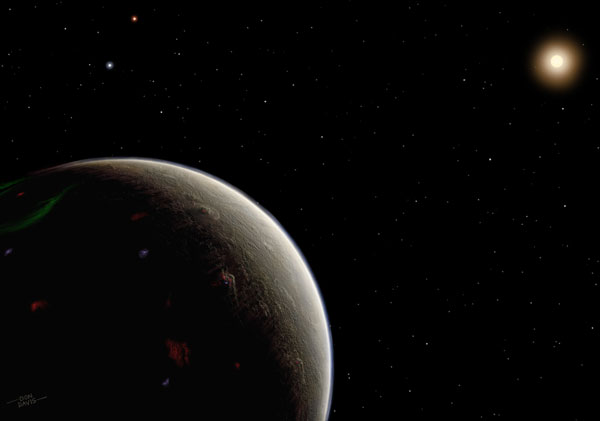 An artist's illustration shows a super-Earth candidate orbiting 40 Eridani. That candidate didn't pan out — the repeated signal came from stellar activity, not the gravitational tug of a planet.
40 Eridani A is an orange-ish K0 star 16.3 light-years from Earth in the southern constellation Eridanus. The star, which is slightly less massive than Tau Ceti, is also visible under dark skies at 4.4 magnitudes.
In 2018, astronomers announced the detection of a planetary companion using the radial-velocity technique. That planet, 40 Eridani b (named Erid in the movie), would have had a mass more than 8.4 times Earth’s, making it a super-Earth with strong gravity. While the host star isn’t as luminous as the Sun, the planet would have orbited on a period only 42 days long, putting it in the star’s habitable zone. Besides inspiring Weir's plotline in Project Hail Mary, 40 Eridani was also home to Star Trek's planet Vulcan, so the find delighted many a sci-fi fan.
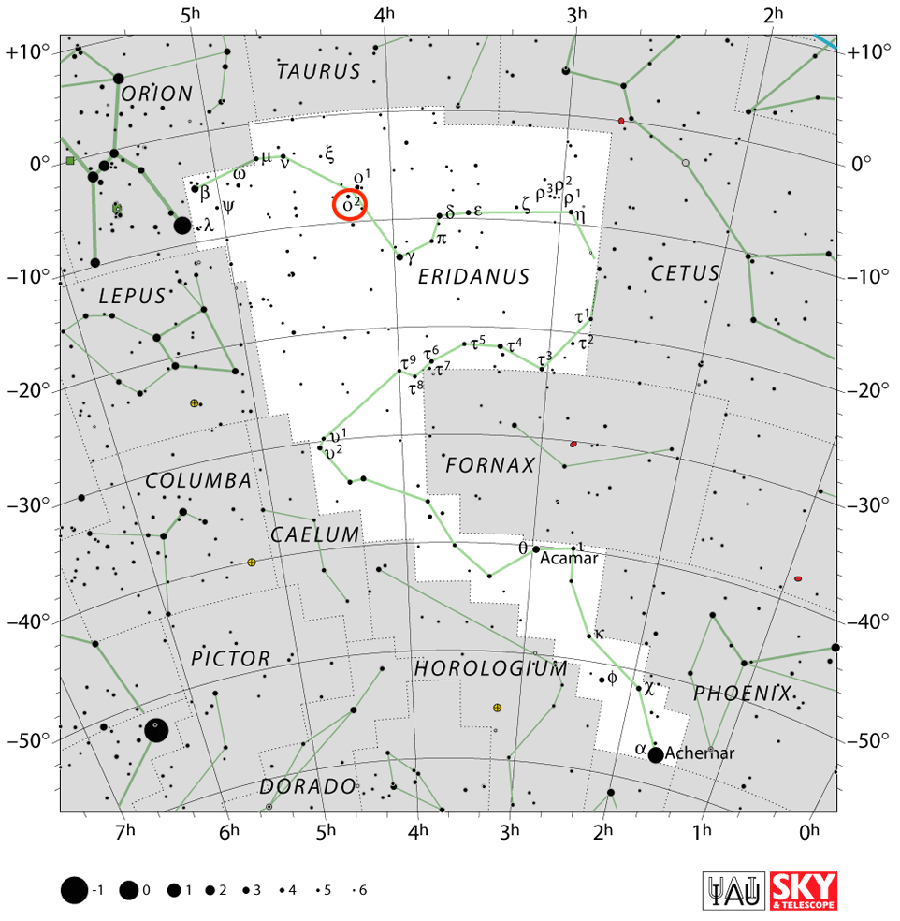 The 40 Eridani system (circled; also known as Omicron2 Eridani) belongs to the southern constellation Eridanus, the River.
Sadly, the planet did not survive the test of follow-up observations. The 42-day period matched the star’s rotation, so it wasn’t too surprising when a 2024 study showed that the radial-velocity signal came from stellar activity.
For the sake of discussion, though, let’s say the planet exists as it was originally discovered. With at least 8.4 times Earth’s mass, it’s possible for the world to be either a gaseous sub-Neptune or a rocky super-Earth. Most planets of this mass are gassy, but the possibility of a rocky world with a thick, ammonia-rich atmosphere (as proposed in the movie) isn’t out of the question. While the gas giants Jupiter and Saturn both have ammonia only in trace amounts, super-Earth atmospheres might contain far more volatile gases like ammonia. As presented in the movie, Erid is certainly plausible, even if it doesn't exist in real life.
It’s worth noting that Project Hail Mary, the book, was published in 2021, well before the latest studies on Tau Ceti e and 40 Eridani b came out. Weir used the best data available at the time he was writing to construct these fictional worlds.
Sci-fi writers and astronomers with proposals to pen will have a new resource today, as Kaltenegger and colleagues have tallied up a catalog of 45 previously discovered rocky worlds that are in their star's habitable zones, released today in the Monthly Notices of the Royal Astronomical Society. The team identified TRAPPIST-1d, TRAPPIST-1e, TRAPPIST-1f, and TRAPPIST-1g (40 light-years away) as well as LHS 1140b (48 light-years away) as the most interesting and accessible planets for study. Indeed, astronomers have actively been pursuing JWST and other observations of these worlds.
As with all scientific discovery, finding the exoplanets — or even disproving their existence — isn’t an endpoint. It’s yet another beginning in the continuous process of detecting, testing, hypothesizing, and testing again. True scientists, Grace included, remain open to change and — when change inevitably happens — they persevere.
Comments (0)