
Remember me
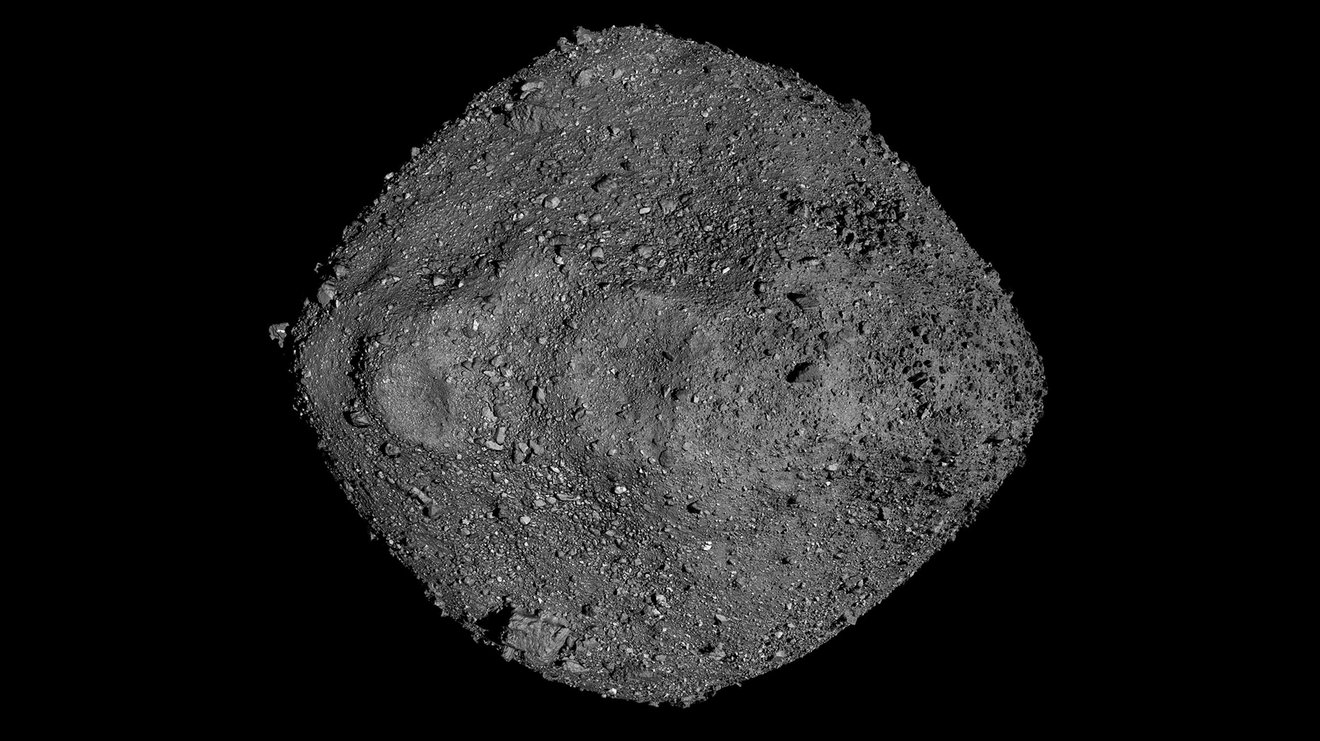

 Astronomers were surprised by the jagged boulders strewn all across the surface of the asteroid 101955 Bennu.
 NASA’s Origins, Spectral Interpretation, Resource Identification, and Security-Regolith Explorer (OSIRIS-REX) delivered 4.29 ounces of pristine material from the asteroid 101955 Bennu to Earth in 2023. But before that sample-return could take place, the spacecraft first had to land — and that was easier said than done.
The surface of the asteroid took astronomers by surprise. Instead of the smooth, sandy surface they were expecting from earlier infrared observations, they saw a jagged world covered in boulders. A new study published in Nature Communications reveals the cause of this discrepancy — extensive networks of cracks in the boulders cause them to masquerade as sand. The result could aid further asteroid exploration, or even planetary defense.
Sand vs. BouldersIn preparation for the OSIRIS-REX mission, the Spitzer Space Telescope observed Bennu in 2007, measuring how quickly the surface heats up and cools down (a property scientists call thermal inertia). Anyone who has walked on a sandy beach during sunset has felt this effect – the sand cools quickly underfoot because air pockets between grains limit how effectively heat can move through it. These measurements suggested the asteroid would have regions of smoother, finer regolith, like a sandy beach — nothing like boulders, which are expected to hold onto heat for a long time.
The contradiction of OSIRIS-REX’s first views of the boulder-strewn surface left scientists searching for answers — answers found through analysis of the samples the spacecraft returned.
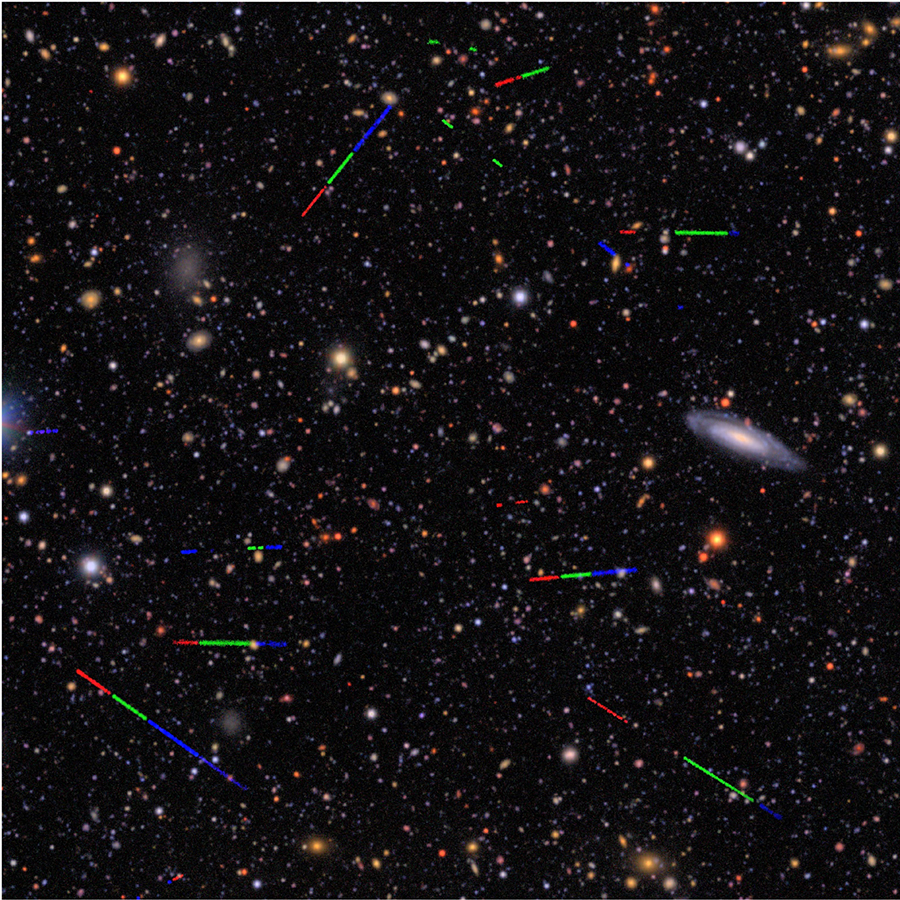
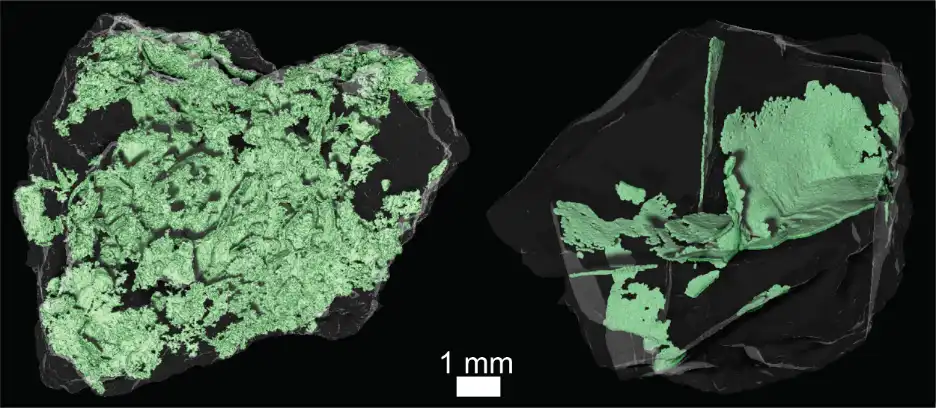 X-ray CT scans of two particles from asteroid Bennu, highlighting in green the most common types of crack networks observed.
 The research team first tested the theory that irregular gaps, or pores, would account for some of the heat loss with laser measurements. But those results failed to complete the picture. Now, new laboratory analysis of the samples found that even the smaller rocks returned to Earth are riddled with microscopic cracks. Porous, fractured interiors provide space for the boulders to lose heat much more efficiently than solid rock, resolving the mismatch between the surface appearance and thermal measurements. The fractures were extremely small and subtle, requiring detailed imaging to fully reveal.
To create 3D maps of rock fragments ranging from submillimeter to centimeters in size, the research group used a technique called X-ray computed tomography (X-ray CT). The results probed not only the samples’ shapes but also their interiors.
Researchers took careful steps to preserve the particle's integrity and avoid exposure to the outside environment. “A lot of the samples are kept in a nitrogen environment to prevent atmospheric contamination,” says team member Ron Ballouz (Johns Hopkins Applied Physics Laboratory). “This is really important for analyzing samples from a carbonaceous asteroid as they are known to readily absorb moisture from the atmosphere, which alters their physical and thermal properties.”
The team used machine learning to identify visible cracks from the X-ray CT data. They then scaled up the scanned particles to boulder size, modeling heat flow with computer simulations. Results confirmed that the networks of cracks in the particles can increase heat loss, explaining Spitzer’s measurements.
With the mystery of Bennu’s heat behavior resolved, scientists are now focusing their attention to the fractures’ origin.
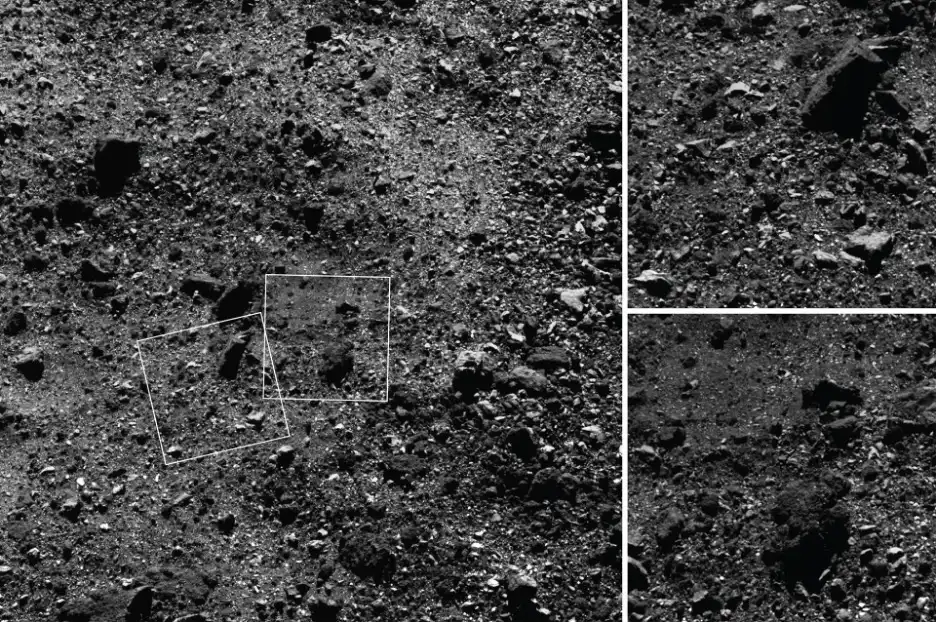 An image of Bennu’s northern hemisphere close up, acquired by NASA’s OSIRIS-REX spacecraft.
 The team first had to investigate whether reentry affected the particles. After all, seven particles within the sample fit together like a puzzle, suggesting they broke apart at some point after their collection. But most of the material was not extensively damaged, and even when samples broke, tests known as controlled splitting confirmed they did not develop pervasive new internal cracks.
Instead, it’s likely that the cracks developed on the asteroid itself. Team member Jamie Molaro (Planetary Science Institute), emphasizes that asteroids are not inert hunks of rock. “These worlds are dynamic, active environments with landscapes that are changing and evolving just like larger bodies,” Molaro says. Micrometeorite impacts and thermal fatigue could create cracks, for example.
The results have implications beyond a single asteroid. Small, carbon-rich bodies like Bennu are common throughout the solar system, and scientists often rely on infrared observations to interpret their structures. Asteroids’ microscopic structures are key to that interpretation – and not only for when we want to land on these objects. There may come a time when we want to reroute something that’s heading our way.
“Finally understanding how to interpret observations from Earth to understand this abundant group of solar system objects better prepares us to design spacecraft that will explore, understand, and if needed, deflect these asteroids,” says meteorite curator Tim McCoy (Smithsonian Institution).