
Remember me
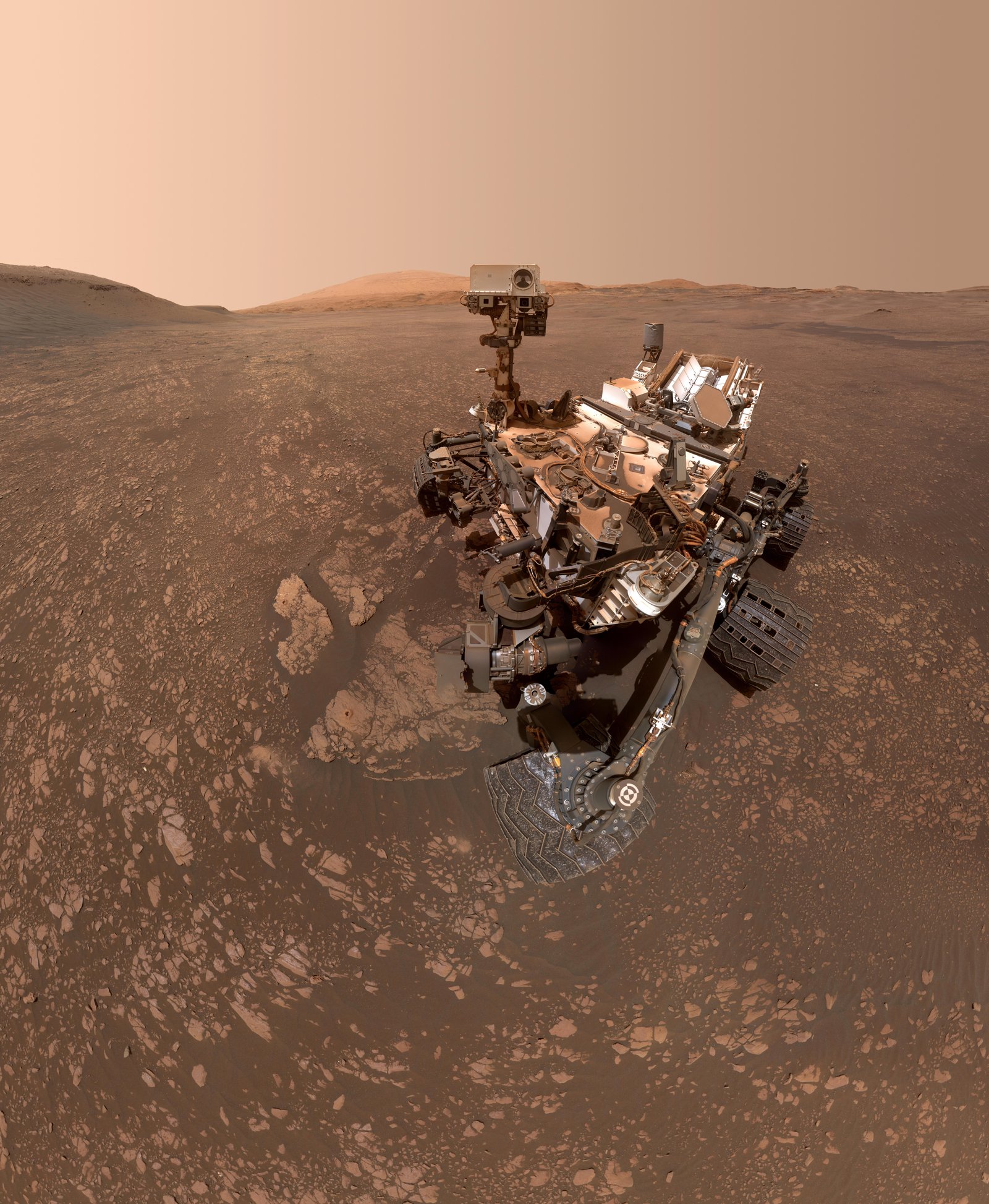


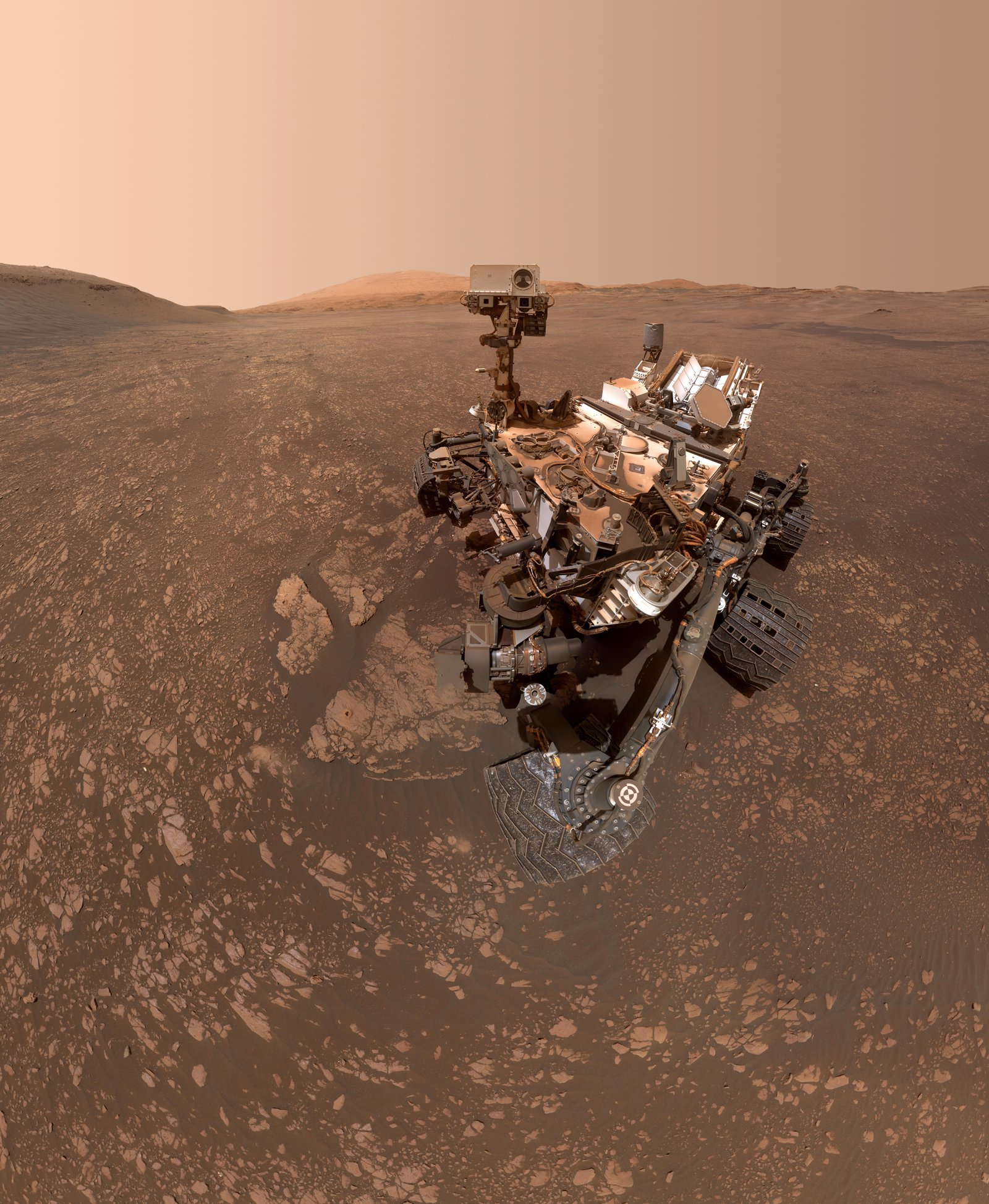 NASA's Curiosity Mars rover took this selfie on May 12, 2019 (the 2,405th Martian day, or sol, of the mission). To the lower-left of the rover are two drill holes, at targets called "Aberlady" and "Kilmarie."
Many Waters Mixed on Mars
Geologists like to say that “every rock tells a story.” The texture and the chemical and mineral compositions record a history of geologic events and environmental conditions. The older a rock is, the more history has happened to it. Like a palimpsest, the original story recorded in the rock may be erased and overwritten with a new one. Figuring out the overlapping stories can take years.
That was the case for a drill sample the Curiosity rover took out of the Martian ground in a clay-rich region of Gale Crater called Glen Torridon in 2019. Graduate student Taiko Hirai (Earth-Life Science Institute, Japan), presented his analysis of the sample at the Lunar and Planetary Science Conference in Texas last week, stating evidence that a subsurface environment once existed where complex organic molecules could have formed.
The Curiosity team had been looking forward to exploring Glen Torridon because even from orbit, the signature of clay minerals was strong. Clay minerals require water to form. What’s more, that water must be neutral to alkaline — unlike the acidic waters that made the sulfate-rich rocks explored by Curiosity’s predecessors, Spirit and Opportunity. When Curiosity reached Glen Torridon, it drilled at two locations, named Aberlady and Kilmarie. The rover’s arm delivered the Kilmarie sample to one of the precious few remaining pristine cells in Curiosity’s CheMin, an X-ray diffraction/X-ray fluorescence instrument capable of directly identifying the minerals in the samples.
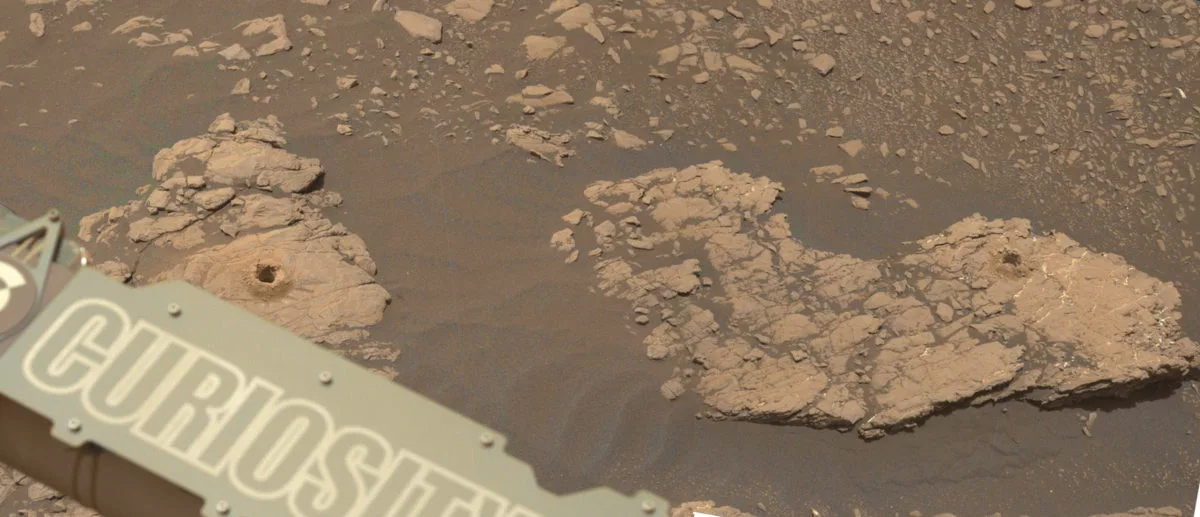 Curiosity drilled at Aberlady (left) on sol 2370, and Kilmarie (right) on sol 2384.
 But the chemistry of the Kilmarie drill sample was a puzzle, Hirai explained. In most respects, its mineral makeup suggested it had once been buried deep underground. There, it would be chemically isolated from Mars’s carbon dioxide–rich atmosphere, and the groundwater filling its pore spaces would be slightly alkaline. For example, the rock contained siderite (iron carbonate) and the unusual clay minerals greenalite and minnesotaite, all of which could have formed by crystallizing out of the alkaline groundwater, cementing the buried sediment into rock.
These kinds of slightly alkaline conditions are exactly what Curiosity was sent to Mars to study, to look for ancient habitable environments. But two pieces of chemical evidence didn’t quite fit in this scenario.
“The iron concentration is comparable to, or even higher than that of magnesium,” Hirai noted. “However, this is very strange, because basically, magnesium is more soluble than iron.” Soaking a typical Mars basalt in water for geologic time should produce groundwater that has more magnesium than iron in it because of the different solubility. When such water goes away, it leaves magnesium-enriched deposits behind, like the magnesium sulfate veins that crisscross Gale crater rocks. At Kilmarie, there was too much iron.
In addition, sulfate in the samples hints at chemistry in acidic water. Yet siderite would dissolve if dunked in enough acidic water.
Since one drenching of groundwater couldn’t explain the chemistry of the Kilmarie sample, Hirai tried a different setup. Water from a different source could have come into contact with the wet rock — as might happen if a new lake formed in Gale Crater after the Kilmarie rocks had been buried beneath its surface. We know that later in the crater’s history, its surface water became more acidic. (That water created sulfate-rich rocks that Curiosity is exploring right now.) So it’s plausible that a pulse of acid water descending from the surface could have mixed with the groundwater already there in the Kilmarie rock. The mixture could explain the unusual combination of alkaline-preferring minerals (siderite and greenalite) alongside the presence of acid sulfates.
The mixing of these two flavors of water is an exciting prospect, Hirai said. Where they meet, there’s a gradient in the chemical environment that’s ideal for the creation of complex organic molecules, the kind necessary for life. Such an electrochemical gradient could even be a source of life-sustaining energy itself.
There’s one challenge to that idea: the sample’s excess iron relative to magnesium. But one more tweak to Hirai’s model could explain it.
Hirai pointed out that the iron- and magnesium-rich flavors of olivine, one of the major constituent minerals in Mars’ basaltic rocks, dissolve in acid water at different rates. Fayalite, the iron-rich version, dissolves more rapidly than forsterite, the magnesium-rich version. So if the acid lake water did not have very much time to react with the Martian rock, it would dissolve more fayalite than forsterite, and end up with more abundant iron. Hirai found that if the lake water had less than 100 years to react with surface rocks before percolating downward, it could explain the unusual abundance of iron in the Kilmarie sample.
Here, then, is the story told by the chemistry of the Kilmarie sample: Once upon a time, there was a long-lived lake in Gale Crater. Rivers supplied it with water and sediment, eventually building up such thick deposits that the deeper layers turned to rock, cemented together by minerals precipitating out of alkaline groundwater.
These deep layers of rock didn’t know that far above them, Mars was losing its atmosphere. Mars’ surface chemistry changed, its arid landscape only occasionally wet with acid rain that pooled in short-lived, acidic lakes. Some of that lake water evaporated to leave sulfate-rich deposits on the surface. But some of those waters seeped into the ground, following fissures downward until they encountered much older, alkaline water. There, they delivered a pulse of chemical energy that drove reactions deep beneath the Martian surface. And since the surface water brought with it dissolved carbon dioxide from the surface, it provided a ready source of carbon to make organic molecules — and possibly support life.
Comments (0)