
Remember me



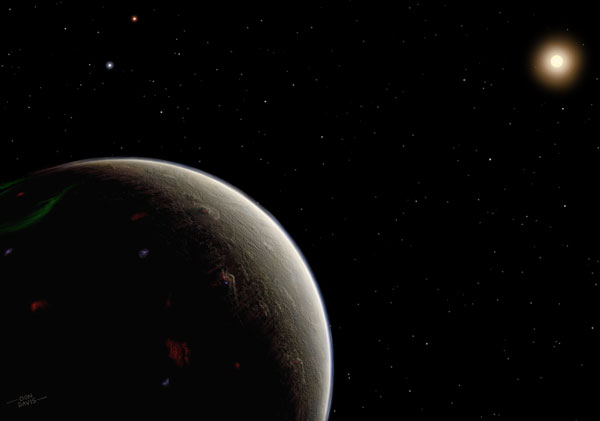


 Researchers have spotted a very tight-knit pair of brown dwarfs, named ZTF J1239+8347, in which one is actively siphoning material from the other, as depicted in this artist's illustration. Ultimately, the brown dwarfs are expected to merge to form a new star; alternatively, the brown dwarf gaining the extra mass will ignite to become a star. Either way, a pair of failed stars will have created a brilliant new star.
 Astronomers have spotted two brown dwarfs in a close binary pair, with one stealing gas from the other. The discovery, made in data from the Zwicky Transient Facility (ZTF), marks the first time astronomers have observed this behavior in brown dwarfs.
Brown dwarfs straddle the borderline between planets and stars — they’re often called “failed” stars. With masses between 13 and 80 times that of Jupiter, they don’t have the gravitational power to sustain fusion in their cores, which is the calling card of a star. But their formation has been contested: Do they form around host stars like planets do? Or do they collapse out of gas clouds independently as stars do? The new pair hints at star-like formation.
Binary Brown DwarfsA team led by Samuel Whitebook (Caltech) found the unprecedented binary pair by trawling through the ZTF Variability Archive, a catalog of 2 billion changing objects observed since 2017. The findings are published in Astrophysical Journal Letters.
The two brown dwarfs, known together as ZTF J1239+8347, sit 1,000 light- years away in the constellation Ursa Major. They orbit each other so closely that they would fit between Earth and the Moon.
While other pairs of brown dwarfs are known, they are usually widely separated and evolve largely independently. Finding two brown dwarfs locked in an ultra-tight orbit, and actively exchanging material, pushes them into a category more commonly associated with stars.
“When one star's gravity is overcome by the other’s, matter starts flowing from the less dense star to the denser star,” Whitebook says. “It’s like the matter sloughs off through a nozzle.”
The same thing is happening to the pair. This siphoned material strikes a concentrated area on the other brown dwarf, leading to a hotspot that glows in blue and ultraviolet light. As the brown dwarf rotates, this hotspot comes in and out of view. Its changing light is what alerted Whitebook and his team to the binary pair.
The signal itself is extreme. The system brightens and dims by more than two magnitudes over just 57 minutes — one of the most dramatic variations ever seen in an object this faint. The team’s modelling suggests that the material striking the surface is heated to nearly 9,000 kelvin, far hotter than the brown dwarf’s usual atmospheric temperature of around 1500K.
“These are very exotic objects,” says team member Tom Prince (Caltech). “We've told some of our colleagues about them, and they didn't believe such a thing exists.”
“It is something I can’t think of any other explanation for,” says Trent Dupuy (Royal Observatory Edinburgh, UK), who was not involved in the research. “Two faint objects undergoing mass transfer is the best explanation.”
The FutureThere is a certain poetry to the discovery. “The failed stars get a second chance,” says Whitebook. “Brown dwarfs don't have internal engines like stars do, but this result shows they can exhibit very interesting dynamic physics.” The future of the pair remains uncertain, with the possibility that they’ll merge to become a star.
“The most interesting thing to me is that such systems should be quite hard to form,” says Dupuy. They must end up in an exceptionally tight orbit without merging or being torn apart, a balance that current formation models struggle to produce. Understanding how such systems emerge and stabilize will be key to determining how common they are.
Whitebook’s team are planning follow up observations of ZTF J1239+8347 with the James Webb Space Telescope. And while this is a maiden discovery, Whitebook doesn’t think it will be the last.
"We expect the Vera C. Rubin Observatory to detect dozens more of these objects," he says. "We want to find more to understand the population and how common it is. We predict this happens more than you think."
Comments (0)